Showing posts with label reflections. Show all posts

Friday, August 31, 2012

small smile

   I hang up the phone with a smile on my face.  It’s strange because I’ve just been talking with a woman in my church whose husband has just passed away.  He had suffered a severe stroke some weeks back, had fought hard, but had eventually succumbed to the damage.  I had been up to the hospital to see him.  He was in pain.  Nonresponsive.  In those moments there’s really only one thing you can do.  I lowered myself into the chair at his bedside and began to pray.  Perhaps, more often than not, that is the only thing we are really supposed to do after all.  Surrender the pain, the confusion, the anger: asking the Lord to “come and see” the sorrow, like Mary when she meets Jesus after Lazarus has died.  We find in Mary the invitation each of us has to ask Jesus into our sadness, our grief, our sorrow.  And he comes, himself weeping.  My Saviour isn’t afraid to cry.  We can enter into the grieving together.

   Death has a way of infiltrating our senses.  The colour of the wall looks muted.  Familiar sounds dull.  We find ourselves doing menial tasks without much thought—keeping busy, I suppose—or we’re crumpled, deflated, emptied of all that feels good and right.  I remember hearing the news that my Grandpa Cain had died.  I think it was the first day of school, 1999.  Dad told me.  I was standing in the kitchen by the dishwasher, myself suddenly awash with a strange mixture of relief and sadness: relieved that the pain and sickness were finally over; sad that it had ever happened at all.  Lord, come and see.

   So what caused the smile this morning?  It was the remembrance that beyond the death and pain, there is indeed a light that shines out the clearer.  A light that does not nullify or ignore the potency of such a sting, yet bathes us afresh in memory and witness anew.  The light is hope.  Hope that rushes to the tomb and finds only folded grave-clothes.  Hope that carries still the scars of sorrow, yet is healed and made whole.  Hope that calls friends to a shore-breakfast of the morning’s catch.  Hope not as abstract principle: Hope who is a Person.  That Person who is no longer dead, but living again.  The same Person who promises that same hope for us: that death be forever broken of its power, that life be restored and renewed again in the morning of New Creation.  This is the Hope of Resurrection—made real and alive in Christ himself.  And this is why I smile, for in that simple phone call—a small gesture, attempted by a pastor to bring comfort, to simply be and be still in the presence of those in mourning—I could hear Hope already awakened and alive in her heart.  And it was beginning even then to spill over and fill me with hope.  The pain isn't over, certainly.  But it is no longer all that is.
“There, peeping among the cloud-wrack above a dark tower high up in the mountains, Sam saw a white star twinkle for a while. The beauty of it smote his heart, as he looked up out of the forsaken land, and hope returned to him. For like a shaft, clear and cold, the thought pierced him that in the end the Shadow was only a small and passing thing: there was light and high beauty for ever beyond its reach.”  -  J.R.R. Tolkien, The Return of the King
Amen.  Come and see us, Lord Jesus, come and see.

Thursday, July 05, 2012

the company we keep

Hello!  It’s been some time since posting.  The last month has been full: two weddings with a trip both west and east, moving to full-time pastoring at the Church, saying good-bye to my work and employers at PRT, celebrating our 3rd anniversary, camping with Sarah and her brother, Josh, and enjoying this beautiful summer.

This week I wanted to provide some sermon resources for what I shared on July 1st.  I’m not sure if these will be regular addition or not, but if they can be beneficial to anyone who couldn’t make it out to church or is simply interested in diving more deeply into the text and ideas of last Sunday.

Click here to access the sermon notes, summary and reflection questions for our message from July 1st.

The Peace of Christ,
Nikolas


Summer Laundry

Thursday, May 24, 2012

where the eating and the remembering are one


This past Mother’s Day, Sarah and I were having coffee with Mom and Dad and my Auntie Laurel and Uncle Don, and somewhere along the way they got talking about what life was like during their childhoods.  “There were no supermarkets,” said Uncle Don.  Their memories grew more and more elaborate as they recalled early-morning milk deliveries, fresh baked bread from the bakery, old propane tanks along the house, tabs at the corner store, woodstoves and glass pop bottles.

Remembering is a key part of what it means to be human.  We could almost say that our memories are essential to who we know ourselves to be.  We reminisce over the little moments, and we pay homage to the big events like where we’ve lived, who we’ve known—who we’ve loved.  When we take the time to savour these memories, we find ourselves being drawn to see our lives as a story and as a journey.  We learn how we came to be living here and now.  Good remembering can teach us who we are.

Now there’s a difference between a simple reminder and these sort of active, full-bodied acts of remembering.  Being reminded is, I would like to think, a thing that happens to us—something outside tweaks our brains to recollect a fact or appointment.  “Dance Lessons @ 6:45”,  “Pick up the kids @ 3:00”, “Get lettuce on the way home.”  That sort of thing.  Reminding might lead to remembering, but it is not in and of itself of the same quality.

Remembering involves action.  We retell the stories.  We re-enact the moments.  We draw others into the memory.  “Remember when the van broke down with the wedding dress inside?”  We allow the meaning of an event or a person to saturate our minds, our hearts, and our imaginations.  It gets inside us.  We become changed.

If remembering is so essential to human life, it is therefore essential to the Christian life.  The people of God are called to be a remembering people.  We are a people who are being changed and made anew through the love of Him whose life has invaded our lives: Jesus Christ.  “The Word became flesh and blood and moved into the neighbourhood.”  (John 1:14 The Message).  When we immerse ourselves in the story of Scripture we find that God is often teaching us that we must learn how to remember well if we are to stay in stride with all that is going on in this Father-created, Christ-redeemed, Spirit-blessed world.  Take these stones, build this altar, make a memorial, eat this meal.  This kind of remembering involves real people: hands and shoulders which carry altar stones, feet to walk across riverbeds, voices raised in adoration, eyes lifted, words spoken, legacy passed on.  Biblically speaking, remembering is an embodied thing.  There’s more going on here than just the firing off of electrons in our brains.  Our whole selves are present in active remembrance.

The Church is to be a remembering people.  She is a community of memory and of hope.  The Bible draws our attention both to our pasts in gratitude, and to the future glory in anticipation and expectation.  We live out our remembering in the present: in the already and not yet of the Christ's Kingdom.  All of this is bound together, sharpened, clarified, and exalted when we gather together the worshipping, praying, witnessing community to the most poignant act of remembrance:  the sharing of a meal.

Alexander Schmemann, one of our best writer-poet-pastors on the subject, gets us pointed in the right direction:  In Genesis we find that man is created hungry.  God provides for him trees and fruit, a garden, of which to eat.  God gives the world to man to become his food.  In eating, man takes the world into himself and it becomes sustenance to the flesh and blood of man.  The world is transformed into life.

In the Bible the food that man eats, the world of which he must partake in order to live is given to him by God, and it is given as communion with God. . . . All that exists is God’s fit to man, and it all exists to make God known to man, to make manes life communion with God.  It is divine love made food, made life for man.  God blesses everything He creates, and in biblical language, that means that He makes all creation the sign and means of His presence and wisdom, love and revelation:  “O taste and see that the Lord is good.”[1]

          So we come to the table, a place of family and sharing together.  We come to eat.  We take food into ourselves and it nourishes us and is transformed into life.  Only here, we find that Christ has offered himself as food for us.  He becomes the Life which will nourish and sustain and transform us:  “Take and eat.  This is my body.  This is my blood.  Do this in remembrance of me.” 

          As Stanley Grenz so right puts it: "We not only announce the truth we also mysteriously participate in this grand event."[2]  We retell the "old, old story", we respond to his gift of himself to be our food--our nourishment, our sustenance--our life.  He invites us to the table, to join with the family for the meal.  

          And so we come: eating, remembering, and living.


   “Let me go over with you again exactly what goes on in the Lord's Supper and why it is so centrally important. I received my instructions from the Master himself and passed them on to you. The Master, Jesus, on the night of his betrayal, took bread. Having given thanks, he broke it and said, 

   This is my body, broken for you. 
      Do this to remember me.
   After supper, he did the same thing with the cup: 
      This cup is my blood, my new covenant with you. 
      Each time you drink this cup, remember me.

   What you must solemnly realize is that every time you eat this bread and every time you drink this cup, you reenact in your words and actions the death of the Master. You will be drawn back to this meal again and again until the Master returns. You must never let familiarity breed contempt.”


1 Corinthians 11:23-26 The Message


[1]Alexander Schmemann, For the Life of the World (Crestwood, NY: St. Vladimir’s Seminary Press, 1963), 25.
[2] Stanley Grenz, Theology for the Community of God (Grand Rapids: Broadman & Holman, 1994), 522.


Thursday, April 19, 2012

Easter Life

Though the holiday itself has passed my mind has been filled this week with Easter. We're in a season of newness (at least we're supposed to be--it is spring after all!); this has really struck home for Sarah and I as we entered into this week: a new job, a new office, a new world of thoughts and questions and possibility. I'm typing this out to you from the Pastor's Office, wondering at how I came to be sitting here: thankful for the opportunity and gift it is, and also, to be honest, somewhat anxious at all the responsibility and expectation that comes along for the ride.  Transitions are like that: even the good ones, the best sought ones, bring both excitement and nervousness, joy and apprehension.  Such is change.  Such is newness.


And such is Easter.


I've been preparing my first real message as a pastor for Sunday morning: focusing again on the significance of Easter Life, and integrating some of my hopes and dreams for us as a Church.  John 20 is also about transition, and it brings these two places of startling contrast together: the fear and despair of Mary and disciples is embraced and dissolved in the encounter with the Risen Lord.  They had believed this was transition without tomorrow: hope lost, death victorious.  Yet not so.  The Saturday Dark gives way to Sunday Glory.  Newness, life, renewal spring forth--spring forth with and in and through Jesus and his Resurrection.  


This changes how we approach life, rewrites the rules on how we interpret pain and suffering.  Christ invites us live as whole, renewed, redeemed people.  His people.  We don't always.  We still suffer and sway between fear and joy--but we're not without hope.  Easter Life means finding that hope in the midst of grief; life in the midst of death: knowing Christ and the power of his Resurrection (Phil 3:10).


This song has captured this for me today as I write and pray for you.
Be blessed, my friends.


Nikolas


Saturday, December 10, 2011

simple

As we were getting ready for bed last night we got talking about how much stuff we have.  We’re reminded of this regularly since our main storage area also has the laundry and a shower in it—so you see these things that you don’t really use very often.  Some of it is definitely important like our winter clothes, my drum cases, and some bins of old papers and/or toys from our childhoods.  Sometimes it feels like the wall of storage is encroaching on the rest of the room!  If we were in a bigger place we’d probably have it tucked away somewhere else.  But in the same breath, we’d also have bought more stuff to fill a larger home!  Endless cycle!

One of the things I love about Sarah is that she’s so good at deciding what is important to keep and what she’ll never really use again.  She goes through her clothes on a regular basis and what she doesn’t think she’ll use anymore she gives away.  When I was a kid and a teenager Mom would do the same with me: sit me down and we’d go through the old cupboard.  Cleanse things out.  Make room for what we actually need for today.

I’m thinking of looking at spiritual disciplines as a series for Sunday school in January.  Why do we make things so confusing?  Look at this horse!  He seems pretty happy just to have food and space to run around.  Plus he's got a great view.I’ve been wanting to do something with Richard Foster’s book Celebration of Discipline for some time now, but I’m still not sure this is the best outlet.  The chapters in Celebration are already so well arranged that I think any one of them would be hard to present in a 45-minute segment.  Also Foster highlights 12 disciplines…and I have room for maybe 4-5!  So I’d have to pick some and skip others.  Part me of just wants to hand copies of the book out: “Here.  Read this through and then come back and we’ll talk about it when you’re done.”  I wonder how’d that go over?

The Christian Discipline of simplicity is an inward reorientation which, in turn, transforms the way we go about living life.  Inward to outward, always both.  What begins inside of us will permeate our outward experiences.  Out of the heart the mouth speaks, so I’ve heard. Here’s Foster:

Contemporary culture lacks the inward reality and outward lifestyle of simplicity.  We must live in the modern world, and we are affected by its fractured and fragmented state.  We are trapped in a maze of competing attachments.  One moment we make decisions on the basis of sound reason and the next moment out of fear of what others think of us. We have no unity or focus around which our lives are oriented. …

We really must understand that the lust for affluence in contemporary society is psychotic.  We crave things we neither need nor enjoy. … We are made to feel ashamed to wear clothes or drive cars until they are warn out.  The mass media have convinced us that to be out of step with fashion is to be out of step with reality.  It is time we awaken to the fact that conformity to a sick society is to be sick. . . .We should take exception to the modern psychosis that defines people by how much they can produce or what they earn.” (Foster, Celebration of Discipline, 80-81).

Foster paints it pretty bleak, and I’m not saying that everyone is sucked into this 100%.  But it’s hard not to think of real experiences when I read this.  Especially the stuff about mass media.  It’s one of the reasons why Apple drives me nuts.  They redesign their iPods so quickly that once you buy one it’s not long before you feel that they missed out, and then you feel the need to upgrade sooner than you would really need to.  It’s the same now with Amazon’s Kindle e-book readers.  I’m sure the same thing goes for cellphones, but I don’t really know.

Simplicity.  I’d rather ignore all the rubbish of having the newest and the fastest and get my inner life straightened out first. Out of that I know I can be a better husband, a better employee, a better son, a better drummer, a better person.  The fundamental reorientation of the heart and mind, when set aright by God, can really transform our attitudes and the way we go about living day-to-day.  I’m far from this.  But Foster helps to point us in the right direction.  I’m glad for voices like his that can cut through the system and get us thinking again.

If you’re still reading this than kudos to you!  Way longer than I intended for first thing Saturday morning!  Have a great weekend.

Monday, August 29, 2011

the whole sweep

One of biggest changes that college wrought in me was a new perspective on my faith.  There’s this phrase C.S. Lewis uses where he thinks of our imaginations being “baptized”, that is that our faculties—our hearts, minds, spirits, what have you—are enlarged in order to better experience or understand or take in that which we were before unaware of.  My imagination was enlarged in an attempt to grapple (not fully understand mind you, but to witness and acknowledge) the vastness of God: his transcendence, his immanence, his humanity in Christ, his mystery in Spirit.  That was day 1: Theology I, actually.  And it was onward and upward from there. 

I mentioned once before that I’ve been reading Luci Shaw’s Breath for the BonesAt one point she’s talking about journal-keeping, and how when we re-read our journals it’s like taking a helicopter ride back over a landscape where before we had only walked or hiked.  At the time we saw only the particulars, the individual ups and downs of the experience.  In reflective hindsight we see the whole scope of the thing, be it a year or a decade; and we can get a sense of the lay of the land, so to speak.  Spiritually this can be really helpful, for so often in the day to day we miss out on the overall theme.  We can’t see the forest through the trees.

This idea of looking at life by the small blips or by the vast panorama can come into play in how we read the Bible.  I know for myself, one of the things which Eston encouraged in me was to read whole books in one sitting.  I seldom actually did this, but the value was not lost on me: in reading the whole of say, Ephesians, or John, we can see how the whole thing works.  Now we might not dissect and analyse the thing as we’re doing so…and that’s perfectly alright!  For that tendency to study the text should not, I think, come before first reading the text: hearing it as a Story.  Getting into the lives of the characters, seeing how they went about working out their relationships to God…how God was working out making himself known to them.  We let the text work on us.

I like how Eugene Peterson puts it in his introduction to 1 & 2 Samuel in The Message: 

The biblical way is not so much to present us with a moral code and tell us “Live up to this”; nor is it to set out a system of doctrine and say, “Think like this and you will live well.”  The biblical way is to tell a story and invite us, “Live into this.  This is what it looks like to be human; this is what is involved in entering and maturing as human beings.”  We do violence to the biblical revelation when we “use” it for what we can get out of it or what we think will provide color and spice to our otherwise bland lives.  That results in a kind of “boutique spirituality”—God as decoration, God as enhancement.  The Samuel narrative will not allow that.  In the reading, as we submit our lives to what we read, we find that we are not being led to see God in our stories but to see our stories in God’s.  God is the larger context and plot in which our stories find themselves.

Such reading will necessarily be a prayerful reading—a God-listening, God-answering reading.

I love that.  And I feel drawn back into that world that I discovered in those years at Eston.  For they encouraged us in that same way…not to see God as an object to be studied, but as the Subject within whom we find love and forgiveness and wholeness again.

So, I’m on a mission to read in wholes.  And what I love is that this requires imagination-living.  Not that we’re making things up!  But we need our imaginations baptized if we’re to be able to see our day to day lives, and our day to day reading of Scripture as part of something bigger.

This morning I happened upon a video which is what first enticed me to write some of these thoughts down:

N.T.Wright "The whole sweep of Scripture" from Rodica on Vimeo.

Favourite line:  “Frequently and thoroughly!”

So may you see whatever is on your plate today as a part of the bigger story of your life.  May you know that no matter how difficult things might seem, that there is One who knows you, who feels your pain, and wants to guide you through it.  And may you read not with the intention of mining out some small particular for personal pleasure, but may you find yourself immersed in God’s goodness as you are “swept along” by the Story.

Sunday, August 21, 2011

new old hymns

   Received an unexpected gift today at work.  Rendy pulled out an album of Fernando Ortega’s music and said we could have it or pass it on to someone who might be interested in it.  I thought the name sounded familiar but couldn’t place it.  So I surfed over to his website and stumbled upon his blog.  He was reflecting on song-writing, and also on the lack of thoughtful literary artistry that seems commonplace in congregational worship music. 

   His conclusion was what really stood out to me:

I didn’t set out to write a didactic blog. I’m writing to myself. Be specific when you write songs about God. Avoid cliché. Avoid convenience. Avoid an obsession with the consumer. Avoid the temptation to make commercial success your central goal. Write with intelligence, employing all the craft, skill, and experience with which God has endowed you. (Fernando Ortega, “Come Down, O Divine Love”, http://www.fernandoortega.com/fernandoortega/blog/blog)

   His advice could be for any artist, not just the hymn writer.  There is a common attitude today (or perhaps it has been with us for centuries) that we create for a consumer.  What will people like?  What will sell?  Those are legitimate questions, but I don’t think they should be the bottom line.  If we begin to think of money or success as an end in and of itself (an attractive one, to be sure), then I wonder if we miss the bigger picture?  To tend towards the cliché, the consumer, the commercial success at the expense of intelligence, skill, craft, mind and imagination is indeed a grievous thing.  How much more so when the Art is intended as worship?

   I was also reminded of my friend, Koko, whom I wrote about earlier.  Koko is now an urban missionary in Victoria, where one of his projects is writing hymns to go along with liturgy at his Anglican church, The Table.  I think Koko embodies the attitude that Ortega is getting at in his blog.  I wonder what the world would be like if more people avoided writing the cliché for commercial success and focused instead on bringing all of themselves into their art, seeking to point others toward beauty and truth.  I wonder if we’d be able to feel the difference in the music they’d create?  I think so.  I think it’d be really cool.

Saturday, July 09, 2011

reading slowly

   I’ve been getting into Eugene Peterson’s The Message translation of the Bible.  We were reading the Beatitudes last night.  There’s so much hope here; each sentence is a tasty morsel worth savouring slowly.  I find that certain beatitudes stand out to me, speaking to me about where I am in my life. 

You're blessed when you're at the end of your rope.
With less of you there is more of God and his rule.
 

  You're blessed when you feel you've lost what is most dear to you.
Only then can you be embraced by the One most dear to you.
 
  You're blessed when you're content with just who you are—no more, no less. That's the moment you find yourselves proud owners of everything that can't be bought. 

  You're blessed when you've worked up a good appetite for God.
He's food and drink in the best meal you'll ever eat. 

  You're blessed when you care.
At the moment of being 'care-full,' you find yourselves cared for.
 
  You're blessed when you get your inside world—your mind and heart—put right. Then you can see God in the outside world. 

  You're blessed when you can show people how to cooperate instead of compete or fight.
That's when you discover who you really are, and your place in God's family. 

  You're blessed when your commitment to God provokes persecution.
The persecution drives you even deeper into God's kingdom.

The Message (Matthew 5:1-10)

   There are these moments that come when I find myself really wrestling with what direction I’m heading, and I’m wondering, “God, what’s happening here?  Where is this going?”  There’s this struggle that I think a lot of us face all too often where a barrage of questioning and wondering and guilt and worry gets stirred up inside of us.  Inside of me.  I have a choice in that moment: I can succumb to that overwhelming, pressing deluge or I can surrender myself to the care of my God. 

   And if I do that, if I surrender myself to Him, He takes that ugly mixture of pain and stress and anger and fear and he begins to work on me until suddenly I don’t see the storm anymore.  That’s where I find myself in the beatitudes: in the 6th one, where my inside world—my mind and heart—are put right.  And then I can start to see the bigger picture: the ways in which God is so deeply at work in my life and in our world.

   And I know that I have been blessed.

Tuesday, June 28, 2011

picking up where we left off

It’s a beautiful idea, especially between friends.

I was struck by the reality of this during the weekend while Sarah and I travelled to Regina and were part of Anna and Daniel’s wedding.  The first person I saw as we arrived at St. Mary’s for the wedding rehearsal was Sean.  Here’s a friend who I’ve RAed in my second year, who I RAed a dorm with in my third year, who I shared an office with in my fifth year.  A good friend, a man I’ve had some great conversations with, and some great bouts of laughter too.  And it was so good to return to that.  To find that the relationship is right there, ready to be ‘dusted off’ in a sense, and started afresh again.

Now, obviously, this does not always happen with friends.  I remember a friend of my once saying that you can only really have 10 or so close friends.  Friends who you pour into, and who pour into you.  I’m not sure if that’s true, but I have definitely seen friendships drift apart.  Perhaps your first reaction to this, like me, is to get worried and try to work hard to keep that friendship enriched.  Yet sometimes, I think it’s natural—perhaps even right—that we drift apart.  Life changes, and so do we.

That’s what is so interesting about picking up again.  Even though life can change—sometimes drastically—there are those people, albeit, unfortunately for some, a rare few, who regardless of the gradual, natural drifting can easily become companions again.  dorm 2 boysThere are those kindred spirits who, after that first hug and hello, slip back again into the camaraderie they once knew.  And that is something to never take for granted.

So here’s to those friends who we saw this weekend: may you be blessed, just as you have blessed me.  Our time together is sometimes too short.  So let’s savour every moment, and sop up the last bit of gravy with a good piece of bread.

Sunday, April 03, 2011

being and doing

Had these thoughts brewing for awhile…

   Life is about who we are, not just about what we do.  And who we are, though heavily made up of what we do, is also more than just the sum total of what we manage to accomplish with ourselves. 

   What I do speaks to who I am.  My job fulfills an aspect of who I am: it fulfills a healthy desire and need to work.  Work for my food, work for the sustenance and provision of my family.   That is what I am given for my work: monetary allotment which is intended to relate to the value, quality and difficulty of the work. 

   And yet work is much more than that.  There is something good in and of work itself.  It has intrinsic value, whatever the vocation or location, regardless of pay or not.  We are designed to work.  We find this in the Genesis accounts where God gives Adam and Eve the task of tending to Eden, to naming the animals, for exercising healthy dominion over the land and its creatures.  There is good work set before us.  It fulfills us in some fashion.  It should.

   Yet we so often sever work as not speaking to our being.  We lop off the what we do from the who we are—or we dangerously enmesh the two: we are only what we do or accomplish.  The first disintegrates our lives, fragmenting our experience into compartments.  The second sees no distinction at all: it is these people who, should they lose their jobs entirely border on suicidal tendencies.  “There’s nothing left to live for.  That job was all I had.  It was who I was.”  Both extremes, I think, can be dangerous.

   Instead of thinking of who we are and what we do, the being and the doing, as distinct parts of ourselves we need to see them as part of the process of understanding who we are as whole people.  I act out of who I am, and what I do also shapes who I will become.  An illustration that might help us here is that of an upward moving spiral.  Are being impacts our doing, and our doing speaks to our being, yet there is also progression: we are moving forward, growing older, changing, learning.

   In our Spiritual Theology class at College, Lauren introduced us to Parker Palmer and the idea that “we live our way into a new way of thinking, we don’t think our way into a new way of living.” 

   Living is both: it’s the doing and the being.  It’s finding that they are not distinct aspects of myself, but part of a whole.  Biblically we find that the doing and being are wound together in one another.  This where we often have trouble with the Book of James: we see so much of it as doing, seemingly apart from the being: from the work of Christ in our lives who has saved us.  But James is not advocating for salvation by works: his point is that because of the work done in our hearts, because of how we’ve been changed—live it!  If you’re not living it then you haven’t seemingly changed.  It should make a difference.

   Jesus transforms lives.  He transforms the living: both the being and the doing.  Who we are and what we are about.  He reminds me that I am more than one or the other, and more than both.  In light of Him, who I am and what I do with myself take on fresh meanings.  And that, I think, is where joy lies.

Friday, March 18, 2011

knowing rhythm

     It takes effort to acknowledge rhythm: both our need for it, and how it already is at work in our lives.  We rise, we eat and shower, we speak and are silent, we work and play, we retire for the evening.  Finding rhythm is not so much about creating rhythm as it is about recognizing that which is already present and knowing it for the first time.  As drummers we seek to bring out the inherent rhythm of a song, not to impose our own patterns upon it.  There is already something at work here, behind the scenes, which calls us to attention.

100_5964So how do we start?
How do we attune to those latent rhythms within and around us? 


   I think the first step is in realizing what is directly before us.  I found a reflection by the Monks of New Skete, an Eastern Orthodox monastic community in Cambridge, New York, which I think really relates to this idea:

Planting yourself squarely in the present moment is a condition for being truly alive and happy. . . .Take time to notice.  A freshly brewed cup of coffee that we savor in silence, an invigorating shower that rinses away the past night’s sleep – these are but two examples of daily rites that have the power to lift our spirits and carry us forward through the day.  What counts in these routines is our awareness of them.  We can go through such moments on automatic, or we can discipline ourselves to pay attention to them with a spirit of openness and gratitude.  Keep track of yourself today and see if this is not true: Life feels so different to the one who takes time to notice it. (Rise Up, 55)

   Noticing.  Paying attention.  Being present.  This will take some getting used to!

   Far too often when we hear the words ‘daily rhythm’ or ‘habits’ our minds automatically think of strict adherence to a system of rules, like a boarding school which regulates every spare moment of its students’ lives.  Unfortunately, that image is sometimes the reality.  We can overdo finding rhythms in such a way that we forget the purpose behind having such rhythms in the first place.  And what is that purpose?  To cultivate an inner life which is regularly watered and fed, like a garden, where routine care and work is necessary to keep its world alive.  If our inner lives still feel like a cacophonous zoo in our blustering to achieve a regularly paced routine then perhaps the routine is itself too rigorous or overly detailed.  If finding rhythm is just another check box on a to-do list, we’ve already missed the point.  This is not another thing we do: this is an attitude that we live out of.

We need to start small.  Baby steps.
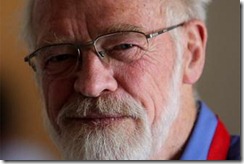
Eugene PetersonIn his reflections on the Psalms, Eugene Peterson draws our attention to the rhythm of language: words and silence.  What we learn from the poetry of the Psalms has much to say about our prayers and our lives.  We need to slow down:

You cannot speed-read a poem.  Poetry cannot be hurried.  We must slow our minds (and, in prayer, our lives) to the pace of the poet’s breathing, phrases separated by pauses. . . . Poetry requires equal time be given to sounds and silences.  In all language silence is as important as sound.  But more often than not we are merely impatient with the silence.  Mobs of words run out of our mouths, non-stop, trampling the grassy and sacred silence.  We stop only when breathless.  Why do we talk so much?  Why do we talk so fast?  Hurry is a form of violence practised on time.  But time is sacred.  The purpose of language is not to murder to the silence but to enter it, cautiously and reverently. (Answering God, 60-61)

   One of my first lessons in drumming with a band—finding the rhythm within the music—was not to fill space haphazardly.  I can still hear the instruction, “Less is more.”  We need to give room to the pockets of silence between sound.  Likewise, we need to be attentive to the moments of rhythm and renewal in our lives, instead of always rushing and seeking to fill our days pell-mell. 

   Less is more.  In drumming less (less hurried, less busy and less sporadic) I found that the beats that are played have greater resonance.  There is space for the skin to reverberate the sound.  The parallels to life are abundant: by learning to slow down and take the time we can discover great purpose in the opportunities before us—even the seemingly menial ones.  The daily routine, so easily dismissed, now come alive with meaning.  This is far from legalistic rule-setting.  This is life!   

   Whatever the specific regularities demanded upon us by our lives or work schedules there are still the general or universal rhythms which nearly all of us find ourselves in.  The basics of life: sleeping, waking, rising, eating, bathing, clothing, working, playing, praying.  

   By choosing to observe these ordinary rites we better prepare ourselves to live: to engage one another, ourselves and our God.  As we slow down and attune ourselves to those daily routines we move from finding rhythm to knowing it.

   Be well this weekend,

Nikolas

Related Posts: 
Finding Rhythm, Truth & Stories, Daring to Rejuvenate, Lessons from the Orchestral Hall  


References:

Rise Up with a Listening Heart by The Monks of New SketeRise Up with a Listening Heart, The Monks of New Skete. New York, N.Y.: Yorkville Press, 2005.


Answering God by Eugene PetersonAnswering God: The Psalms as Tools for Prayer, Eugene Peterson. San Francisco: HarperSanFrancisco, 1989.

Wednesday, March 09, 2011

finding rhythm

Just recently I began giving drum lessons to a new friend of mine from church. I felt honoured by his request—I’m an intermediate drummer, not an advanced professional.  But he reinforced to me that he wanted me to teach him, not someone else.  It was humbling. Opportunities where we are asked to pass on knowledge or skill or wisdom should, I think, humble us.  And remind us that we are growing and learning and getting older: that we do have something to pass on.

Nik's Drums: Pearl Export SelectOn our first lesson together I asked him what he wanted to achieve through these lessons.  We swapped ideas, set some goals, shared stories and then got to work.  Though he’d had some previous informal training, he repeated that he wanted to “start at the beginning, as though I know nothing.” So that’s what we did.

One of the most basic and important concepts for beginner drummers (especially exuberant ones) is the ability to count and play a steady beat continuously over several minutes.  It’s one thing to hammer out a basic rock beat for four bars.  It’s something else entirely to play that same beat for three minutes without deviating the tempo.  So that’s where we began: I’d set a tempo and we’d play through a basic beat for a minute.  Then I’d set another tempo and we’d do it again.  Slowly we began to build up the muscle memory, to fine-tune the movement, to gain a sense of steady rhythm.

A lot of drummers want to get up there and solo.  To them playing drums is about flashy stick spins and flailing limbs.  It’s entertaining and exciting to be sure (and usually incredibly loud!) but is seldom in and of itself a song.  It may serve to get the crowd going during a show, or spotlight the drummer, but it is seldom applied appropriately to music—to the stuff of the band itself.  Soloing is done by oneself; a band implies giving of oneself for the betterment of the group.  It can be fun to drum solo, but the adrenaline wears off after a few moments.  Playing in a band brings a deeper sense of joy, we begin to find pockets where our flourishes are not done outside the larger whole, but contribute to the beauty of all.  In short, learning the slow, steady rhythm can bring about a deeper, more long-term sort of passion…better than the 1-minute solo.

Rhythm.  It’s the drummer’s job to keep the band on track, not to show off.  Out of that steady, regular rhythm the rest of the band is allowed to shine: the guitar, the bass, the keyboard, the vocals, whoever!  Out of that rhythm comes life.  And good drummers can play the rhythm with soul.  The sticking is no longer a series of mathematical figures or hand patterns but a groove.  And from there, from that place of regularity, comes the freedom and maturity to be able to make the song come truly alive.

I say all of that to say this: just as finding a rhythm is key to the true fulfillment of a drummer and the musicians as a whole, so to is finding a daily rhythm to our inner lives so that we might better live in community with others.  At first this may feel boring, as I’m sure it does to the novice drummer.  We’d rather be playing fills: soloing.  Yet a life that is only fills feels devoid of order, of healthy structure.  And a life of soloing is, well, hard to be around.  None of us was meant to live in utter isolation for all time.  And though solitude is itself a valid discipline, most of us are engaged regularly with family, friends, co-workers, fellow students, whomever.  There is a band on stage with us.  And what we do, how we choose to order ourselves will surely effect those closest to us.  By incorporating daily rhythms we can better give ourselves to one another.

Over time, as familiarity is gained, our attitude shifts from begrudging the repetition to appreciating its daily regularity.  Setting the rhythm and keeping at it is the hardest part, especially as we first begin to structure our lives to it.  It can feel constricting, we’d rather be ‘doing nothing’ with our time; or we say it feels ‘pointless’ simply because we can not yet see immediate results (the unfortunate by-product of our instantly satisfied culture) Yet reward does come.  The garden of the inner life needs regular work: tilling, watering, weeding, fertilizing and so on, before we begin to see the fruit of our labour. 

And that’s what seems so contradictory here: that we need to find rhythm, structure, in order to find freedom.  A good drum solo can only be played by a drummer who knows something about playing the regular everyday beats.  For out of rhythm comes to ability to groove, to solo, to react spontaneously at the right moment, to find the freedom.  Daily rhythm does not bind us from life, it opens us up to the fullness of life.

Be well,

Nikolas

Wednesday, February 16, 2011

truth and stories

“What a good movie!  If only it had been a true story…”

Have you ever had this thought?  You’ve just invested two hours in a gripping tale.  It’s got you.  You’re fully engaged in the characters’ struggles and decisions.  You can sense the rising tension.  You know something is about to happen—some unexpected turn or revelation.  The music begins to raise to its crescendo.  And then… then…  the moment is revealed.  Everything falls into proper order.  Resolution arrives.  All is as it should be.  It was so good!  …If only it had been true.

carl and ellie
Up. Disney/Pixar 2009
Sarah and I were asked last summer to give leadership to our church’s young adults group—something that we had wanted to be involved in since leaving Eston last April.  Every second week a group of about three to twelve nestles into our living room and we spend the evening sharing our lives, exploring God’s Word, and praying together.   We’ve been discussing prayer, and how biblically we see individuals praying through their situations: be it anger and sin, doubt or sadness, fear and death.  Though our tendency is bury our experiences within, we have been intentionally attempting to bring what we are going through to God in prayer—allowing him to orient us to perceive our lives anew.  Last week the topic was Praying our Tears, and the first question of the study was “What was the last movie that made you cry?  Why?”  Among the movies mentioned were August Rush, Big Fish, Secretariat, Lion King and Finding Neverland.

There is a certain magic to stories, especially the good ones.  They are meant for far more than distraction.  Yes, they are entertainment.  Yet the best stories do more than just entertain—they touch the core of who we are.  They have an ability to teach us and delight us: to tell us something about life.  If we’re willing to listen.

Saturday, February 12, 2011

daring to rejuvenate

Sarah enjoys going out.  Not anything extravagant--simple things like visiting friends or going to get ice cream or trying some new social activity.  While I'm perfectly comfortable to stay home, doing the same things I usually do nearly every night, she'll be the one to suggest some new outing or adventure.  At first I resist, then, often after being reminded that last time I felt the same way but in the end really enjoyed myself, we'll decide to go.  And it is good.  In fact so often it's exactly what I need right then.  Whether it's visiting with friends when I'd rather sit at home alone, or simply getting out of the house in order to spend some time just the two of us doing something different I come home feeling better, even rejuvenated.  In hindsight I find myself blessed by those moments: opportunities that need to be intentionally taken and lived in to be enjoyed.

The tree nursery often lays off their crew for a month or so in early October, and again just before Christmas until the "big sow" starts up in February.  When I mention to people that I've been off work they'll often say how they wish they had that same free time to "get things done."

I felt that way too.  At first.

I enjoyed sleeping in, showering late, cooking for my wife, reading and watching movies, getting the groceries, practicing drum patterns, all of that.  Yet now that I look back on the time it's easy to see how I could have made more out of it.  Don't get me wrong: I did a lot!  I finished editing my undergrad thesis--something I'd been meaning to do for months!  But do I feel rested now that I'm at the other end of the time?  In some ways, yes.  In others, not really.

Simply having 'no-work' space doesn't automatically make it a space of rest.  We have to choose to holiday.  So often that time of vacation isn't so much about doing nothing as it is about taking the time to rejuvenate.  Rejuvenation comes not from the absence of activity, but from choosing to engage in activities that will restore us.

What are those restorative activities and how can we carve out time to make them a regular part of our lives?

o o o

Thinking about that question triggered another thought.  How can we keep ourselves from thinking only about our rejuvenation?  I mean, we need to take care of ourselves and make healthy choices.  But we also need to help each other.  I was reminded of this in a video clip of Rod Wilson, president of Regent College and professor of psychology and counselling.  He's discussing how we tend to gravitate toward one of those two extremes--thinking only of self and only of others--and how we need a healthy balance.

Given the danger of those two sides: the danger of falling off the side of self-preoccupied, and the danger of falling off the other side--of not even engaging oneself at all--how then spiritually do I function?  Now this is where humility comes in. . . . Humility is not just about Rod's view of Rod, but about Rod's view of Ross and how I conceptualize serving Ross in what I'm doing. . .  Humility is not about my view of myself, it's a way of understanding myself with reference to service.

It's not about me.

So how can we, first, understand this need we have to rejuvenate and take the time to do so regularly for our own health and development; and secondly, how can we seek to foster restorative moments for those around us?

Dare to rejuvenate.  Find that space in your day where you could be doing something that will bring you rest.  Go for a walk, phone an old friend, paint, sing, write, make something, do that thing which you know can restore you--that which makes life's troubles grows smaller (not forgotten, but put in perspective).  Then, having done that, turn around and help someone else to do the same.  We're all in this together!

Be well this weekend,

Nikolas


References:

Friday, February 11, 2011

lessons from the orchestral hall

My first time at a symphony was to hear the music of The Lord of the Rings films by Howard Shore.  Needless to say, it was a truly epic experience.  I had never been to anything of that sort before: the size of the concert hall, the enormity of the orchestra and choirs, that caliber of raw talent and professionalism and passion for music, all the guests dressed in their best (and not a few dressed as Hobbits and Black Riders!)  made for a truly memorable experience.

So when we saw that the Thunder Bay Symphony Orchestra was coming to Dryden we jumped at the opportunity.  Knowingly it would not be the same experience as the LOTR, but we were excited to hear the music and for the opportunity to see some quality entertainment of that variety in our town.  We made it an early Valentine's Day date.

As we entered the auditorium and began making our way to our seats the musicians had already taken the stage.  One could hear short snippets of sound, quiet tuning, the testing of bow on string.  A gentle air of anticipation was about them.  And it was contagious.  After a brief introduction the lights were dimmed and a hush fell upon us.  An air of ceremony.  The concertmaster, Thomas Cosbey, emerged, violin in hand, and took his place at the head of orchestra.  With a simple gesture of his hand he signaled the cue to tune.  There came a rush of slowly building sound. It felt surreal and strange: that those sounds were actually coming from those instruments.  We're so used to hearing music that is removed from actual musicians, especially orchestral music which is so often now only in our lives as the background ambiance in our films.

After the tuning the concertmaster takes his seat as first chair and the hush descends again.  Then the Maestro enters.  We applaud and the orchestra stands to honour him.  He moves to the stand and shakes hands with the concertmaster.  He greets the audience with a smile and a bow.  Then he turns and faces the orchestra.

And the music begins.